


OK Protest 2026
Contemporary Works in the Context of Civil Struggle
Curator: Hadas Yossifon
Tel Aviv-Yafo has always been an open space for critical thinking and civic solidarity. Over the years, it has hosted protests reflecting diverse opinions and perspectives on identity, the environment, housing, livelihood, and peace – testament to a free and pluralistic civil society.
The OK Protest project offers a view of our current time through contemporary video artworks, screened in the museum on a wall dedicated to stories of activism and civil struggles in the city's history.
The seven works screened this year share a focus on sustained effort, both physical and mental. In six of them, the artists themselves embody the action. After more than two years of continuous presence in the streets, against a backdrop of war and loss, the works convey stubborn persistence alongside mounting exhaustion. They present repetitive actions involving labor, investment, toil, and struggles, acts that demand determination in a reality shadowed by doubt about whether the task will bear fruit. Many of the physical and cultural spaces where they unfold are distinctly Israeli.
The effort is great and requires perseverance. These works don't document protests that occurred on the ground. Rather, through artistic action, they articulate the possibility of protest as performance in and of itself – stubborn, sustained bodily gestures enacted within charged spaces. The body stands at the center, dictating the pace and limits of action, bearing the struggle and thereby making it visible. Within these acts, the absurdity of struggle also surfaces, echoing Samuel Beckett: we must go on, we can't go on, we’ll go on.
Opening: 05.02.2026
Exhibition duration: one year
Location: Tel Aviv–Yafo City Museum, 2nd floor
Admission: included in the museum entrance fee
The artworks
Tom Presman, Hole, 2021, video, 3:07 min
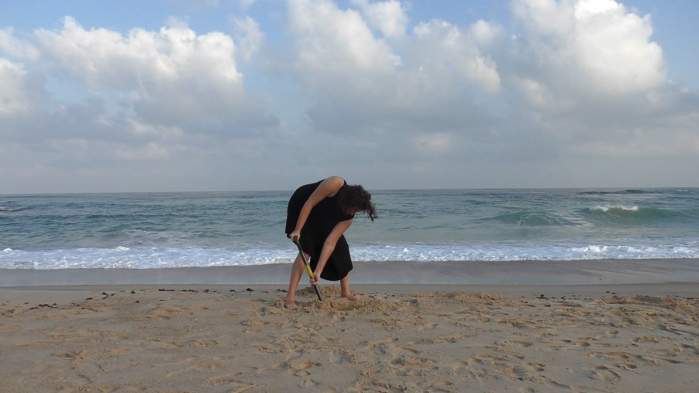 On the Yafo beach, in full view of passersby, a woman digs a pit and buries her head in the sand. The action unfolds in daylight and open space, and yet she seeks to disappear. Opening the series, the work frames joining the protest as a choice rather than a given: Is averting one's gaze enough to escape commitment? Does the unseen still require a response? Here, the expression "burying one's head in the sand" takes on a physical form as an action that creates dangerous circumstances. The attempt to hide requires digging a pit – a gesture in which avoidance itself becomes an act, and refuge reveals itself as both obstacle and self-made trap.
Maayan Mozes Platnic, Mozes, 2024, video, 7:30 min
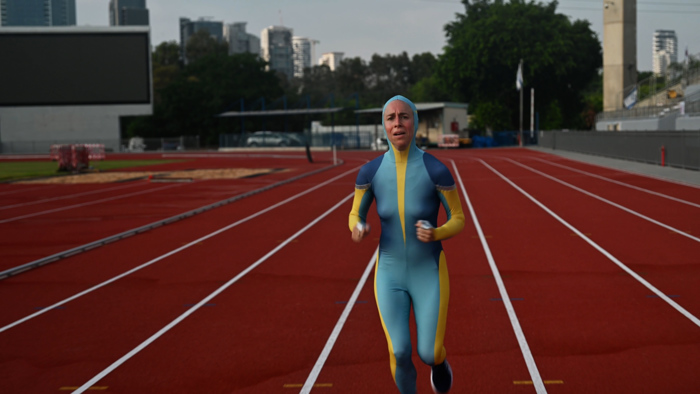
The video shows the artist running strenuously in circles in an Olympic stadium. The work frames protest as a long-distance run demanding steadfast commitment. The running outfit, created specifically for this work, is not a commercial product but a deliberate choice with symbolic weight. Like the T-shirts and signs associated with civic movements, it marks belonging and enables action. In the background, children's voices periodically call out "Mozes" – the artist's family name and the work's title. The name evokes the biblical Moses, chosen to lead his people but denied entry to the promised land. The title, sound, and effort echo the fear accompanying ongoing protests – that they will not deliver.
Shelly Brown, The Party is Over, 2025, video, 2:52 min
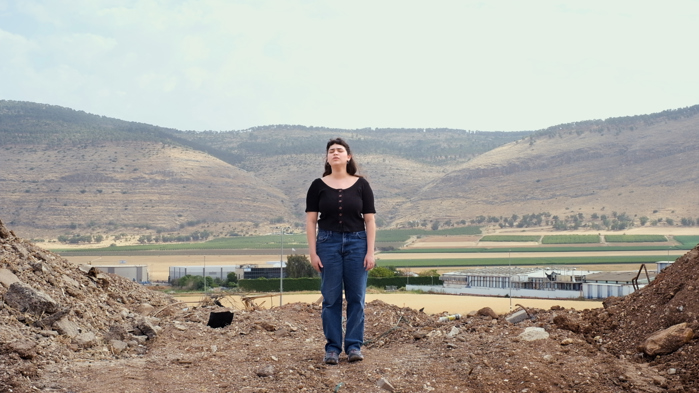
The person at the center of the frame places herself against an idyllic landscape of cultivated fields in the Jezreel Valley – an embodiment of the Zionist dream of land redemption and collective promise. In the foreground, a construction site and ruins emerge. She sings "The Party Is Over" by Naomi Shemer, her voice competing with ambient noise. The effort to sing through an incessant racket becomes a daily battle for space, for voice, for the right to be heard. Her presence is sincere and childlike as she attempts to hold together the song's dual movements of ending and beginning. The work embodies the tension running through the entire collection: resilience shadowed by exhaustion, which gives way to doubt. The meeting of song and reality sharpens the gap between ideal and lived experience. Within this gap, the effort to sing becomes more than a refusal to surrender – it stands as proof that, against all odds, persistence endures.
Neta Fischer, Use of Calm, 2025, video, 5:18 min
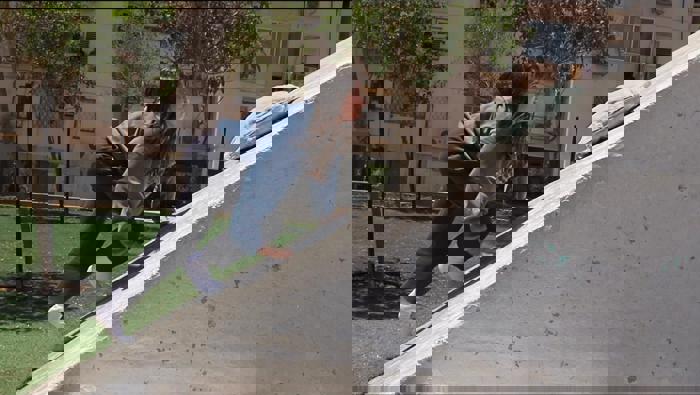
She appears as if suddenly awakened: tired, in pajamas and socks, clutching a pillow. On the sloped surface of a public shelter, she attempts to fall back asleep, climbing repeatedly only to slide backward each time. The repetitive movement recalls childhood games, yet here it becomes charged with relentless effort that never achieves rest. The shelter – an unremarkable fixture of public space – embodies a state of perpetual alertness. Through a body seeking to lay down its head where no repose is possible, the work sharpens the tension between protection and rest. In the context of protest, it stages a direct encounter between the body and a charged environment, examining what the body can endure when rest becomes impossible – in a sustained state of vigilance and unsettledness.
Tamar Binyamini, Sisyphus, 2025, video, 8:42 min
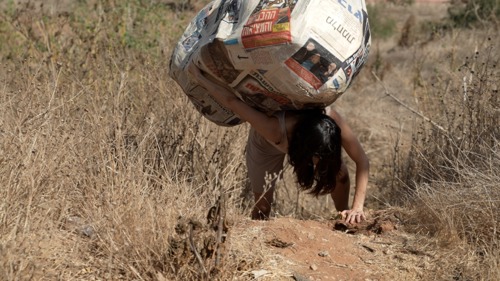
This work embodies a Sisyphean act of hauling a burden uphill. Instead of the mythic rock, the artist carries an object made of Papier-mâchéwrapped in current newspaper headlines. This mass of media accumulates into a heavy load, borne repeatedly through sustained physical effort before sliding back down. The contrast between bodily fragility and the burden's weight raises questions about responsibility, time, and erosion. The repetition reveals protest caught within cycles of information production and consumption, where ongoing violence becomes mere headlines. Suspended between ancient myth and contemporary media-political reality, the work probes the responsibility of body, artist, and viewer alike, to carry, to witness, and to persist even when action seems futile.
Rotem Weizman, Protocol, 2025, video, 6:59
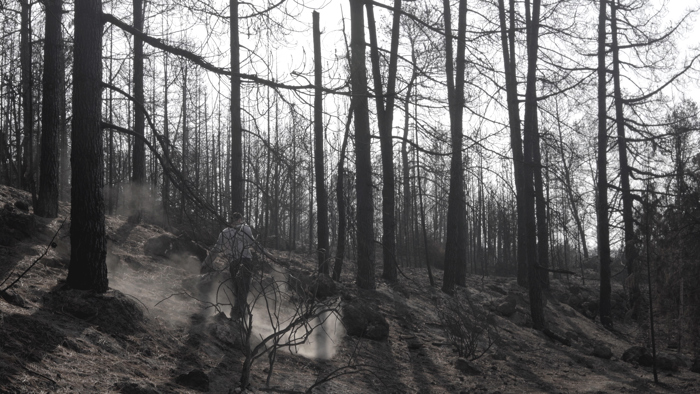
The work explores sustained gazing as a practice of resistance within a dreamlike-apocalyptic state. Resistance manifests as a continuous act of presence and persistence at the margins of visibility, undermining power relations through sheer endurance. The video was shot in a burned forest – a place bearing traces of untold trauma. Within this suspended time, where seemingly nothing happens, appears a figure attempting to position a tree stump. This small gesture fades into the landscape, sharpening the gap between the world's vast dimensions and the body's limited capacity to act. The work presents a protest that does not seek immediate visibility, proposing that even a nearly invisible movement possesses its own existence: it takes place, and therefore already inhabits reality.
Dafna Talmon, Shir LaShalom (A Song for Peace), 2025, video, 2:32
Homage to Bob Dylan's Subterranean Homesick Blues| Artistic advisor: Noa Gross
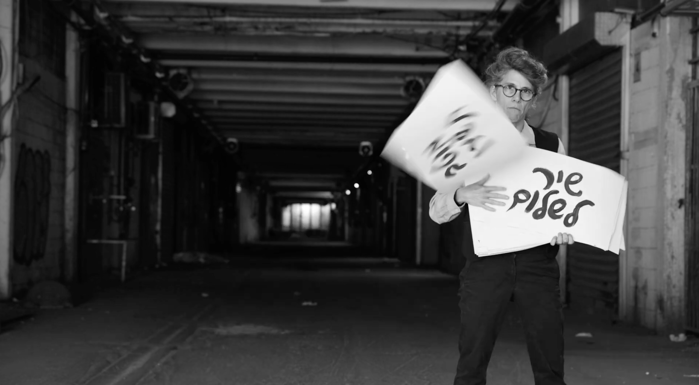
At the entrance to a dark tunnel, the artist stands, throwing sheets of paper one after another, each bearing words from Yaakov (Yankele) Rotblit's "Song for Peace." The rhythm of the falling pages follows the song's progression, allowing those familiar with it to hear the melody in memory even without sound. Since the rally where Yitzhak Rabin was assassinated, the song has embodied a hope cut short – one that has steadily eroded in political reality, reaching an absurd nadir this year when it was briefly banned on Memorial Day. The absence of sound draws attention to the despair and exhaustion visible on the artist's face, and to the question of whether these words can still resonate. Caught between a shattering wish and longing for what is lost, the relentless act of throwing keeps the song present even as it crumbles, preserving a glimmer of hope and light at the tunnel's end.
______________________________________________________________
OK Protest 2025
Contemporary Works in the Context of Civil Struggle
Tel Aviv-Yafo has a rich history of fostering critical thinking and solidarity, serving as a stage for protests on essential issues such as identity, the environment, livelihood, and peace. These protests showcase the ability of civil society to express a range of voices and highlight the significance of creating a community grounded in the values of freedom, tolerance, diversity, and entrepreneurship. These values are essential for building the moral foundation of a life-affirming society. This project presents contemporary works within the context of civil resistance alongside the history of the city’s protests and stories of its activists.
This year’s three works emphasize the body’s essential role in actively engaging with public space. Each work will be shown for one month, with four rotations.
Ori Shifrin Anavi and Michael Shvadron, 100, video, 59 minutes, 2024
Screening during January, April, July, and October
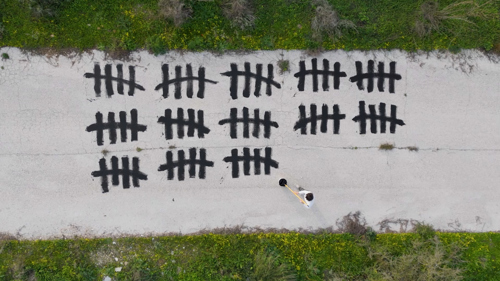
A man draws black lines on an abandoned pathway, counting the days on the cracked surface with a paintbrush and paint. The count marks 100 days since 7.10.2023, 100 days in which the hostages are held captive in Gaza. The hour-long film, shot in a single take, plays in reverse after its completion, transforming the act of marking into one of erasure. The heart trembles, the blood freezes, and time stands still. This is a stark reminder of the shocking number of days that have passed, the growing anxiety about time running out – a declaration that this action will continue until their return.
Oren Fischer, Running Errands, video, 3:32 minutes, 2023
Screening during February, May, August, and November
In an outlandish display of unusual movements, the artist’s lanky figure forcefully traverses familiar public spaces, including halls in banks, municipal buildings, the Ministry of Interior, art galleries, the Western Wall, and the Kaplan protest site. The body’s acute, explosive motions disrupt the bureaucratic environment, communicating feelings of frustration and suppressed anger within these dull, opaque routines spaces. The contrast between the artist’s expressive movements and the subdued surroundings combines humor, satire, and political criticism while questioning art’s ability to impact public space and the role of artists in times like these.
Drowning Together, Smartoot Group, filmed performative action, 3:36 min. December 2023 /
Screening during March, June, September, and December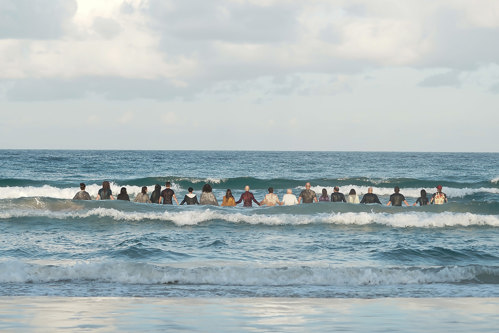
Director and Artistic Director: Avi Gibson Bar-El
A line of people joins hands and steps, open-eyed, into the sea in Tel Aviv until they disappear under the water. This rebellious act serves as an urgent call to end the war and release the hostages in response to a horrible, painful reality. The form and content of this artistic act underscore the existing order and convey an important message to the world to open awareness and hearts. The group embodies a sense of solidarity, representing internal listening, support, strength, and a fundamentally humanistic outlook. It manifests the need for a perceptual shift, reaching out to our partners, combating racism, and acting for change. It stresses our responsibility to dream and strive for a life of sanity and peace. This critical gaze on the current situation reminds us that we are all one live human fabric.
______________________________________________________________
OK PROTEST 2024
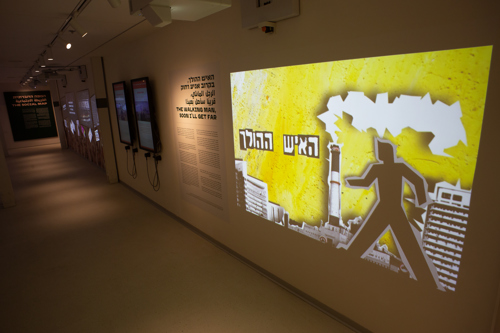
The Walking Man, Soon I'll Get Far
Video, 02:00 min, 2008, 2024
Born on the streets of Tel Aviv, the Walking Man paved the way for current urban activism. His visual language and actions around the city raised the public's awareness of urban planning priorities and generated civil actions.
His various appearances, with their sharp, local wit, refer to the absurd effort inherent in any struggle. With a seemingly carefree aesthetic gesture, his feet planted firmly in advertising logic, he wins over viewers before delivering a surprise. His 2D form, fanzine graphics and modus operandi embody resistance as he turns the environment into a communication channel and challenges official institutions’ dominance over the cityscape.
The Walking Man’s first appearance, a graffiti of the man from the pedestrian crossing sign along with the moto “Soon I'll Get Far,” evolved in the 1990s in a weekly column in the Ha’ir local newspaper and in the city itself via posters, giant sculptures and a fictive municipality campaign that called for the establishment of the State of Tel Aviv. In the 2000s, several exhibitions presented works and actions by the Walking Man, and the Tel Aviv Municipality activism prize was devised in its shape. It was awarded in a ceremony at the museum in its previous incarnation as City Hall, in collaboration with Time Out Magazine. Thirty years after being shredded as garbage, the Municipality installed the Walking Man on the corner of Gordon and Hayarkon streets.
Curator: Hadas Yossifon